The Phone Call Is the Hard Part: Going Back to the Dentist After Years Away
Photo: Internet Archive Book Images, No restrictions, via Wikimedia Commons
There is a specific kind of arithmetic that happens in the car outside a dental practice. You count back. Two years becomes five, five becomes nine, and somewhere around the twelfth you stop counting because the number has become embarrassing. Then you drive home again, and the next time you think about it, the gap is longer still.
If that sounds familiar, you are in very crowded company. The people who leave the longest gaps are rarely the ones with the worst teeth — they are usually the ones with the most dread, and the dread is almost never about pain. It is about the moment a stranger looks into your mouth and, in your imagination, makes a face.
So let us deal with that first, because it is the thing standing between you and a very straightforward appointment.
The lecture you are dreading is not going to happen
Dentists are not shocked by gaps. They see them constantly, across every age and income and background. A dentist looking at a mouth they have never seen before is doing a technical assessment, not a moral one. Nothing in the clinical picture tells them whether you were busy, broke, frightened, unwell, or simply forgot for a few years.
What they will do is tell you what is there, what it means and what can be done, because that is the job. Those are different things. One is a telling-off. The other is information. If you would rather receive it in smaller pieces, you can ask for that, and it is a completely reasonable request.
What the first appointment back actually looks like
Long-gap appointments are usually booked slightly longer, because there is a lot to get through. Roughly, this is the shape of it.
The chat before anything else. Medical history, medications, whether you smoke or vape, any bleeding or heart conditions, and often a very simple question: is there anything you are nervous about? Answer honestly. It changes how the appointment is paced.
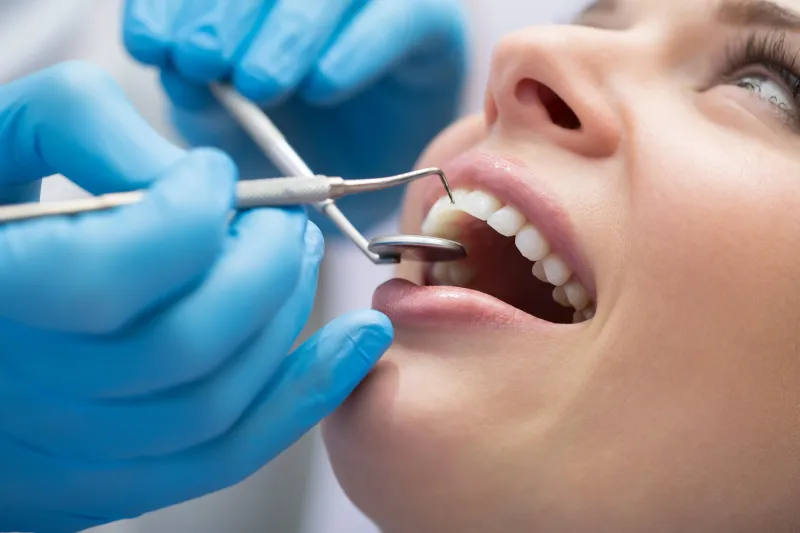
The look. A mirror and a probe around every tooth, checking for decay, cracks, worn surfaces, loose restorations and exposed roots. A soft tissue check of your tongue, cheeks, palate and the floor of your mouth comes as standard at most practices now.
The gum assessment. This is a gentle measurement around each tooth — the numbers you may hear called out are the gaps between gum and tooth. It sounds clinical and it is; it is also the single most useful snapshot in the whole appointment, because gum health is where the biggest gains are available after a long gap.
X-rays, often. If there are no recent images, most practices will take a couple of small ones to look between teeth and under old fillings, where a mirror genuinely cannot see. It is not a commentary on how bad things are.
The conversation. Here is what needs doing now, here is what can wait, here is what can be watched. You should leave knowing the order of things and roughly what it costs.
That is it. Nobody is producing a clipboard of shame.
What the dentist is genuinely looking for
Two things, above all. First, anything urgent or actively harmful — an infection, a broken tooth with a sharp edge, a loose filling, a gum problem that is progressing. Second, the pattern: what is stable, what is changing, and where the risk sits over the next year or two.
Long gaps often mean more than one thing going on, and the useful approach is triage. Fix what is causing trouble, protect what is fragile, then decide what is cosmetic or longer-term. Very few mouths need everything at once. Many need a couple of visits, a scale, some advice and a plan.
Gum disease, in particular, is not a verdict. It is a condition that responds to treatment and to what you do at home, and it responds remarkably well in people who assume they have already lost the argument.
The money worry
Cost is the reason a lot of people stay away, and it deserves a straight answer rather than a shrug.
On the NHS, charges are set nationally in bands and reviewed each April, so check the current prices with the practice rather than relying on a figure you half-remember. A check-up, and any X-rays that come with it, sits in Band 1. If you are under 18, under 19 in full-time education, pregnant or have had a baby in the last twelve months, or hold an HC2 certificate, you may pay nothing at all — it is worth asking before you assume.
Privately, ask for a written treatment plan with costs before anything begins. A good practice will happily split treatment into stages so it lines up with what you can actually afford, and will tell you which items are essential rather than optional. Payment plans exist for larger work. None of that helps if you never make the call, though.
The words to use on the phone
You do not need a speech. You need one sentence, said once, and then the receptionist does the rest. Any of these work:
- 'Hi, I have not been to a dentist in about twelve years and I am quite nervous. Is there a longer first appointment I could book?'
- 'I am embarrassed about the state of my teeth, so I would rather know what is happening as we go.'
- 'Could you put a note on my file that I am anxious?'
- 'If treatment needs doing in stages, what order would you do it in?'
Practices hear all of this every week. It is not a difficult request, and it is certainly not the strangest call of their day.
What happens afterwards
Realistically, you will leave with a plan rather than a finished mouth. There may be a scale and polish, a filling or two, a referral if something needs a specialist look, and a follow-up in a few weeks. You may be asked to come back sooner than the standard six months while things settle — that is a sign of attention, not punishment.
The part nobody warns you about is the drive home. It is usually quiet and slightly anticlimactic, in the best possible way. The number stops growing. The thing you had built up for years turns out to have taken forty minutes and involved a conversation about flossing.
If you have been putting it off, today is as good a day as any to book, and better than most. Ring in the morning, when the diary is open and the receptionist has time to find you the longer slot. The chair is the easy part. The phone call is the hard bit — so do the hard bit first.