The Gap Question: Choosing Between Floss and Interdental Brushes Without Guessing
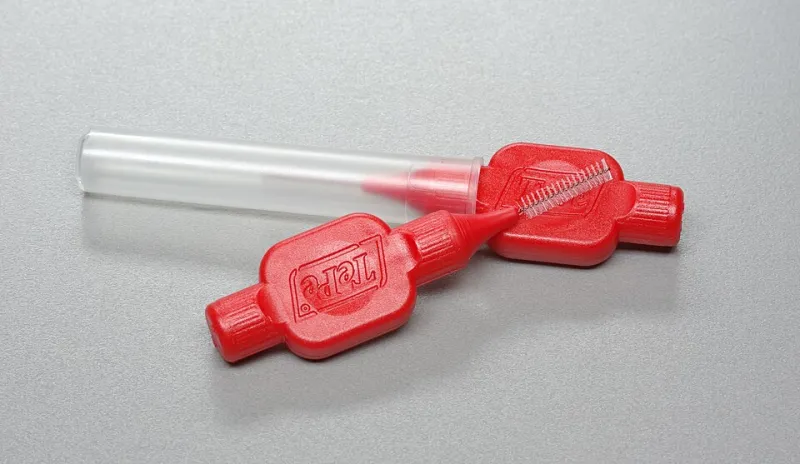
Photo: Berthold Werner, CC BY-SA 3.0, via Wikimedia Commons
Ask ten people about cleaning between their teeth and you'll get a lot of guilt, a bit of defensiveness and one person who's quietly smug about floss. Ask a dentist and you get something far more practical: it depends on the shape of your gaps.
That's the whole thing, really. Not brand, not price, not whatever was in the bathroom cupboard growing up. The single question that decides it is: will a small brush pass snugly between these two teeth?
Why the gap is the whole argument
Cleaning between teeth is about physically disturbing plaque where a toothbrush can't reach. Whatever tool you use has to actually touch the two facing surfaces of neighbouring teeth.
Floss is a piece of string. It cleans by wrapping and sliding against a flat surface. In a mouth where teeth sit tight against each other, that's all the space there is, so floss (or floss tape, or an interdental pick) is exactly right.
An interdental brush is a tiny bottle brush. In a gap of a millimetre or two, it fills the space, brushes both sides at once and sweeps the plaque out. In those gaps it does a more thorough job than floss can, and it's much easier to do well — which matters, because the best tool is the one you'll actually use on a wet Tuesday night.
The evidence, briefly
Reviews comparing the two consistently find that interdental brushes remove more plaque than floss where gaps allow them to fit — and, in practice, people tend to use them more consistently because they're quicker and less fiddly. Floss still has a place; it just isn't the universal gold standard it's been sold as.
None of that means you should feel bad about floss. It means the choice is anatomical, not moral.
Sizing: the step everyone skips
Interdental brushes come in colour-coded sizes, roughly from 0.4mm up to around 1.5mm and beyond. Most people buy one pack and use the same brush everywhere. That's the mistake.
Your mouth isn't uniform. The gaps between your lower front teeth are usually tiny, the spaces near your back molars are often wider, and any tooth that's drifted, been crowned or sits beside a bridge will have its own measurement.
How to pick:
- Start small and work up. If a brush won't go through without a firm shove, it's too big.
- The right size passes with slight resistance — snug, not stuck — and comes out with a bit of give.
- It should fill the gap. If it rattles around, it's too small.
- If you can't get any brush through, that gap is a floss gap.
A dentist or hygienist will size you in about ninety seconds and often hand you a sample of each. Take them up on it. Guessing at the supermarket costs more in the long run.
Technique, minus the lecture
Once daily is the target. Twice is a bonus, not a requirement, and twice-a-week-because-you-hate-it beats nothing.
A simple routine:
- Stand in front of a mirror to start with. You'll get the angle wrong for a week or two without one.
- Slide the brush straight in, don't force it at an angle. Back teeth need a slight curve; that's normal.
- Push through so the bristles clean both sides, then pull out and repeat once or twice.
- Rinse the brush between gaps. Replace it when the bristles splay — usually weekly or fortnightly.
- Brush with fluoride toothpaste afterwards, then spit rather than rinse.
Some people prefer to clean between teeth first, before brushing. It's slightly better on paper, and honestly, either order is fine as long as it happens.
If your gums bleed, don't stop
This is the comfort bit, and it's where most routines die. You start cleaning between your teeth, your gums bleed, and you conclude you're doing damage. So you stop.
It's almost always the opposite. Bleeding is inflammation, and inflammation is what plaque causes. The bleeding usually settles within a week or two of consistent, gentle cleaning. If it's still happening after a fortnight, that's information for your dentist — not a reason to give up quietly.
Be kind to yourself about the learning curve, too. A bit of tenderness for the first few days is normal. Pain that makes you wince isn't, and it usually means the brush is too big.
Where water flossers earn their place
Water flossers are genuinely useful for some people and overpriced decoration for others.
Good fits: braces, fixed retainers, bridges with awkward undersides, implants, anyone with limited dexterity or arthritis, and people who've tried everything else and hated it. They also feel nice, which is not nothing.
Where they're weaker: tight contacts between teeth. A jet of water can't physically get where a brush can't fit, and it won't scrape plaque off a flat surface the way floss does. Used alongside a mechanical cleaner it's a nice extra. Used instead of one, it's usually a downgrade.
The bits nobody mentions
- Bridges and implants need something different again — single-tufted brushes and superfloss earn their keep here.
- Disclosing tablets are cheap and faintly horrifying the first time. They show exactly where you're missing. One a month is plenty.
- Don't be upsold. A basic interdental brush and a packet of floss cover the vast majority of mouths. Fancy handles are a convenience, not a clinical upgrade.
- Bleeding from one specific spot that never settles deserves a mention at your next visit rather than another round of guesswork.
The question to ask next time you're in the chair
'Can you check the size of my gaps and tell me which tool to use where?'
That's it. That's the whole article. Anything that fits snugly, fills the space and gets used daily is doing the job. Everything else is packaging.