Twenty Minutes, Nine Small Checks: What's Really Happening During Your Dental Check-Up

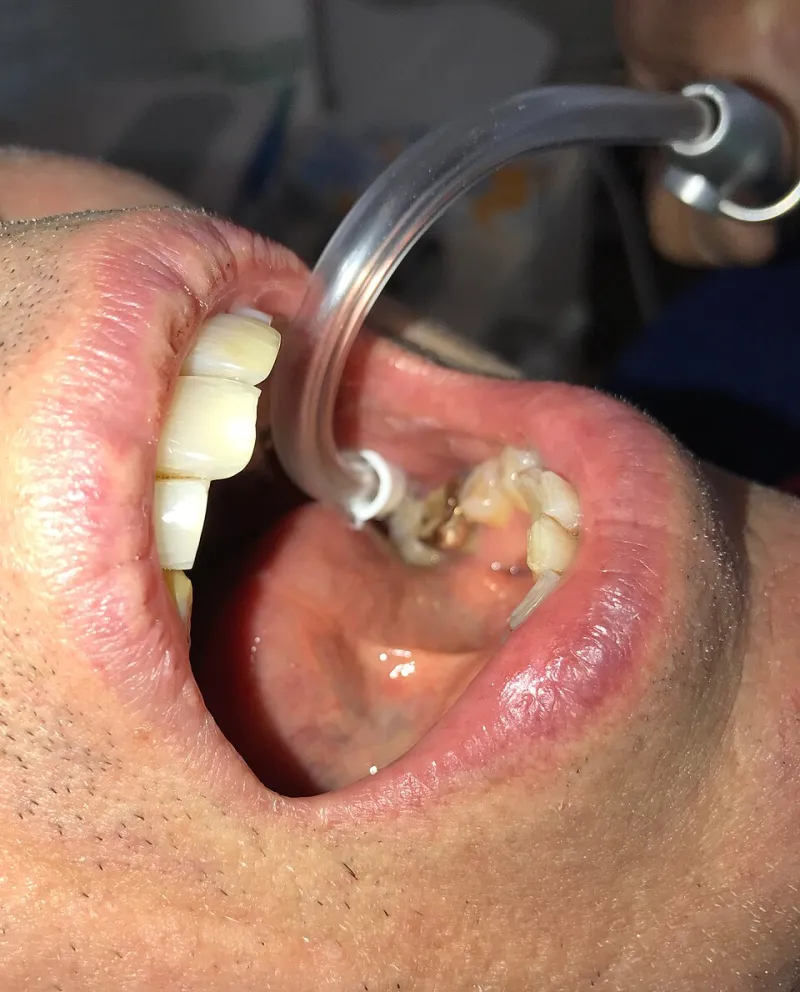
Photo: Unknown, CC BY 4.0, via Wikimedia Commons
There's a particular kind of anti-climax to a dental check-up. You book it weeks in advance, rearrange your morning, sit in the chair, and then it's over before your coffee's gone cold. Twenty minutes, maybe less. A bit of chat. A mirror. A prod. Off you go.
Which is why so many people quietly file it under 'admin' rather than 'healthcare'. But a check-up isn't a quick glance that happens to be free of bad news. It's a structured screening appointment, and once you know what's being looked at, the whole thing stops feeling like a formality and starts feeling like something you can actually use.
It starts before you sit down
Your dentist reads your notes first. Not because they've forgotten you, but because context changes everything. New medication? That can dry your mouth out and put you at higher risk of decay. New diabetes diagnosis? Gum health behaves differently. Pregnant? Gums get more reactive. Started smoking again, or stopped? Both matter.
If something's changed since your last visit, say so early. It's not small talk, it's data.
Your gums get measured — properly
This is the part people rarely know about. Those little numbers your dentist or hygienist calls out aren't a secret code; they're pocket depths. A slim probe goes gently between each tooth and gum, and where there's a full chart done, it's measured at six points around each tooth.
Healthy gums hold the tooth snugly — usually 1 to 3mm. Deeper readings, and especially bleeding on probing, suggest inflammation is quietly loosening that grip. It doesn't hurt, and it isn't a telling-off. It's a baseline. The useful question isn't 'is that bad?' but 'is that number the same as last time?'
The tooth-by-tooth audit
Then come the teeth themselves. Every surface, every filling, every edge. Your dentist is checking for decay in the soft spots between teeth, but also for things that aren't decay at all: worn enamel from an acidic diet, thinning at the gum line from brushing too hard, hairline cracks, a chipped cusp, a filling whose margin has started to lift.
A lot of this is 'watch and see' rather than 'fix now', and that's the point. Small findings caught early are cheap, quick and painless. The same findings two years later often aren't.
Bite down, please
That odd instruction to clench and slide your jaw is an occlusion check. Your dentist is looking at how your teeth meet, whether one side is taking more load than the other, whether there are flat shiny patches suggesting grinding, and whether your jaw joint feels balanced as it moves.
Grinding and clenching are behind a surprising amount of breakage, sensitivity and headaches. Nobody's going to lecture you about stress, but a night guard or a bite adjustment can save a tooth from cracking at 2am on a Tuesday.
X-rays: risk-based, not routine
Bitewing X-rays aren't handed out on a schedule for their own sake. They're used when your individual risk justifies them — a history of decay, lots of existing fillings, and the fact that early decay between teeth is invisible to the naked eye.
Digital X-rays are a fraction of the dose of old film, and the decision to take one should be a conversation. Ask when yours are next due and why. It's a reasonable question, not a suspicious one.
The two minutes that are about more than teeth
Soft tissue screening is the part of the appointment that has nothing to do with fillings. Your dentist will look under your tongue, along the floor of your mouth, around your cheeks, your palate, and feel gently along your neck and jawline for anything unusual.
Mouth cancer is uncommon but not rare, and it's far more treatable when found early. This check takes a minute or two and it's the single biggest reason not to skip appointments when your teeth feel fine.
What's not happening
Worth clearing up, because it causes a lot of quiet resentment. A check-up generally isn't a scale and polish. Cleaning is often a separate appointment, sometimes with a hygienist and sometimes at a separate cost. If you were expecting a clean and got a diagnosis, that's not a bait-and-switch — but it's fair to ask how your practice structures it so there are no surprises.
It's also not a guarantee. A check-up reduces uncertainty; it can't eliminate it. What it does is stack the odds in your favour.
Questions that put you in the driver's seat
Bring two or three of these and the appointment changes character entirely:
- What were my gum readings, and how do they compare with last time?
- Are there any areas you're watching rather than treating? What would tip those into treatment?
- When are my next X-rays due, and what are we looking for?
- Is there anything in my diet, brushing or habits that's showing up in my mouth?
- How often should I be seen, and what makes that interval right for me specifically?
- If treatment is recommended, what happens if I wait three months?
That last one isn't rude. It's the difference between being sold something and being briefed.
The recall interval is a decision
UK guidance sets recall somewhere between 3 and 24 months depending on your risk, not a universal six. If you're low-risk, you might be on a longer cycle. If you're higher-risk, shorter. Either way, it should be a judgement about you, not a default setting. Ask what's driving yours.
Leaving with a plan
A good check-up ends with a sentence you can repeat to someone else: what's fine, what's being watched, what's next. If you leave without that, you're entitled to ask for it — in writing if you like.
Twenty minutes of someone else's trained attention is a decent trade. It's just easier to value when you know what's going on behind the mirror.